




Looking for a Shorter Overview?
AI Summary
Key Moments
Early Near-Extinction and Recovery
NVIDIA almost failed with the NV1 chip but recovered with RIVA 128 and defined the GPU concept.CUDA Platform's Strategic Role
Releasing CUDA in 2006 enabled GPUs for general computing, setting the stage for AI applications.2012 AI Breakthrough with GPUs
NVIDIA GPUs powered the neural network AlexNet, proving deep learning's potential and fueling AI's rapid growth.NVIDIA's Dominance and Challenges
NVIDIA leads the AI hardware market but faces competition, software lock-in risks, and geopolitical challenges.In 2012, three researchers in Toronto did something that would embarrass an entire industry. Armed with two gaming graphics cards — the kind teenagers bought to make video games run smoother — they built a piece of software that could recognise objects in photographs better than any system before it. The cards cost a few hundred dollars each. The results rewired the future of computing, and helped lay the foundation of what we now call the AI economy.
The company that made those cards was NVIDIA. At the time, it was known mostly for keeping PC gamers happy. A little over a decade later, it would become the most valuable company on the planet, worth close to $4.9 trillion, and the quiet supplier of the machinery on which almost the entire artificial-intelligence boom runs. This is the story of how a graphics-chip company became the engine of the AI economy — and how it nearly died, twice, before it got there.
A booth at Denny’s
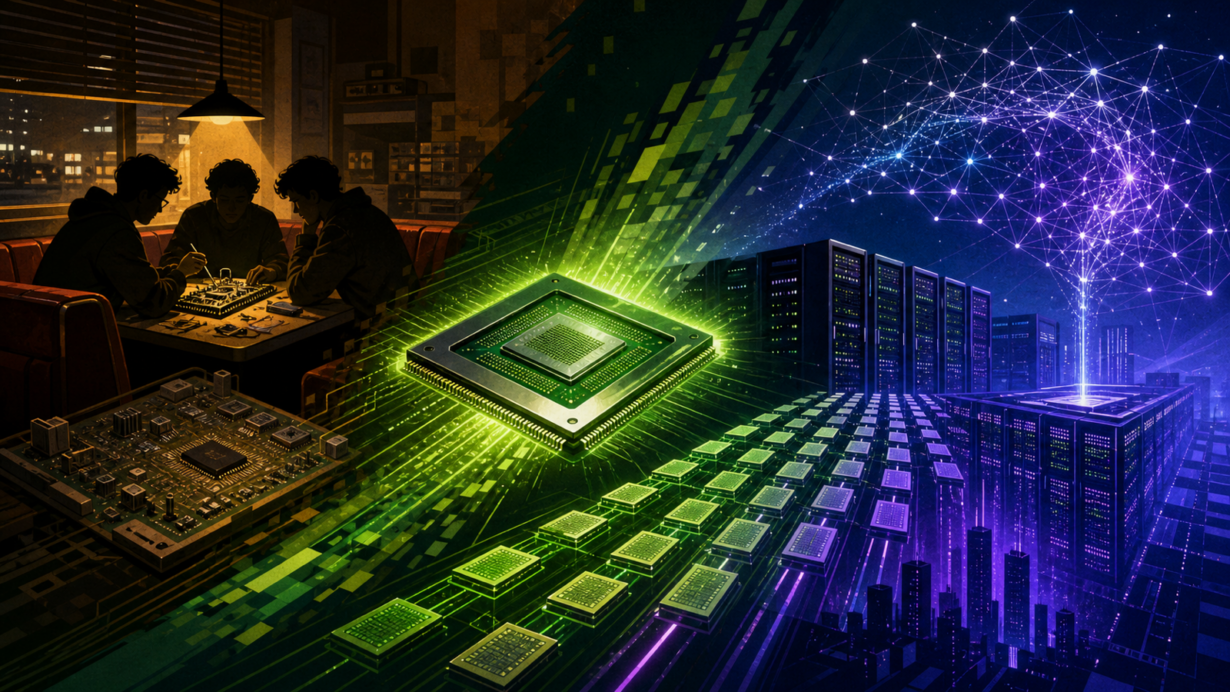
NVIDIA was founded on April 5, 1993, by three engineers who met at a Denny’s near San Jose. Jensen Huang, then a young executive who had waited tables at a Denny’s as a teenager, teamed up with Chris Malachowsky and Curtis Priem, who brought hardware experience from Sun Microsystems and IBM. Over diner coffee, they bet that ordinary computers would one day need dedicated chips to render rich 3D graphics. They started with roughly $40,000 and a conviction that the future of computing would be visual.

The conviction was right. The first product was a disaster.
The chip that almost ended everything
NVIDIA’s debut chip, the NV1, arrived in 1995 trying to do everything at once — 2D graphics, 3D rendering, and audio on a single board. Worse, it was built around an unusual method of drawing 3D shapes using curved surfaces. Just as it launched, Microsoft standardised its new DirectX graphics system around triangles instead. Overnight, NVIDIA’s clever chip was speaking the wrong language. Sales collapsed. The company slashed its headcount from around 100 people to roughly 30 and watched its cash drain toward zero.
This is the first thing worth understanding about NVIDIA: it is not a story of uninterrupted genius. It is a story of a company that came close to extinction, learned brutally from it, and adjusted. Huang later distilled the lesson into a phrase employees still repeat — that the company was always “thirty days from going out of business.”
The turnaround came in 1997 with the RIVA 128, a straightforward, fast graphics chip that spoke the industry’s language. It sold more than a million units in its first four months and generated the cash that kept the lights on. NVIDIA had survived. Two years later, in 1999, it shipped the GeForce 256 and coined a term to describe it: the GPU, or graphics processing unit. The marketing label would turn out to matter far more than anyone realised.
The accident hidden inside a gaming chip
A GPU is built to do one thing extremely well: perform an enormous number of simple calculations at the same time. Drawing a game world means computing the colour of millions of pixels simultaneously, so a GPU is essentially a vast grid of small maths engines running in parallel. A standard computer processor, by contrast, is a brilliant generalist that handles a few complex tasks in sequence.
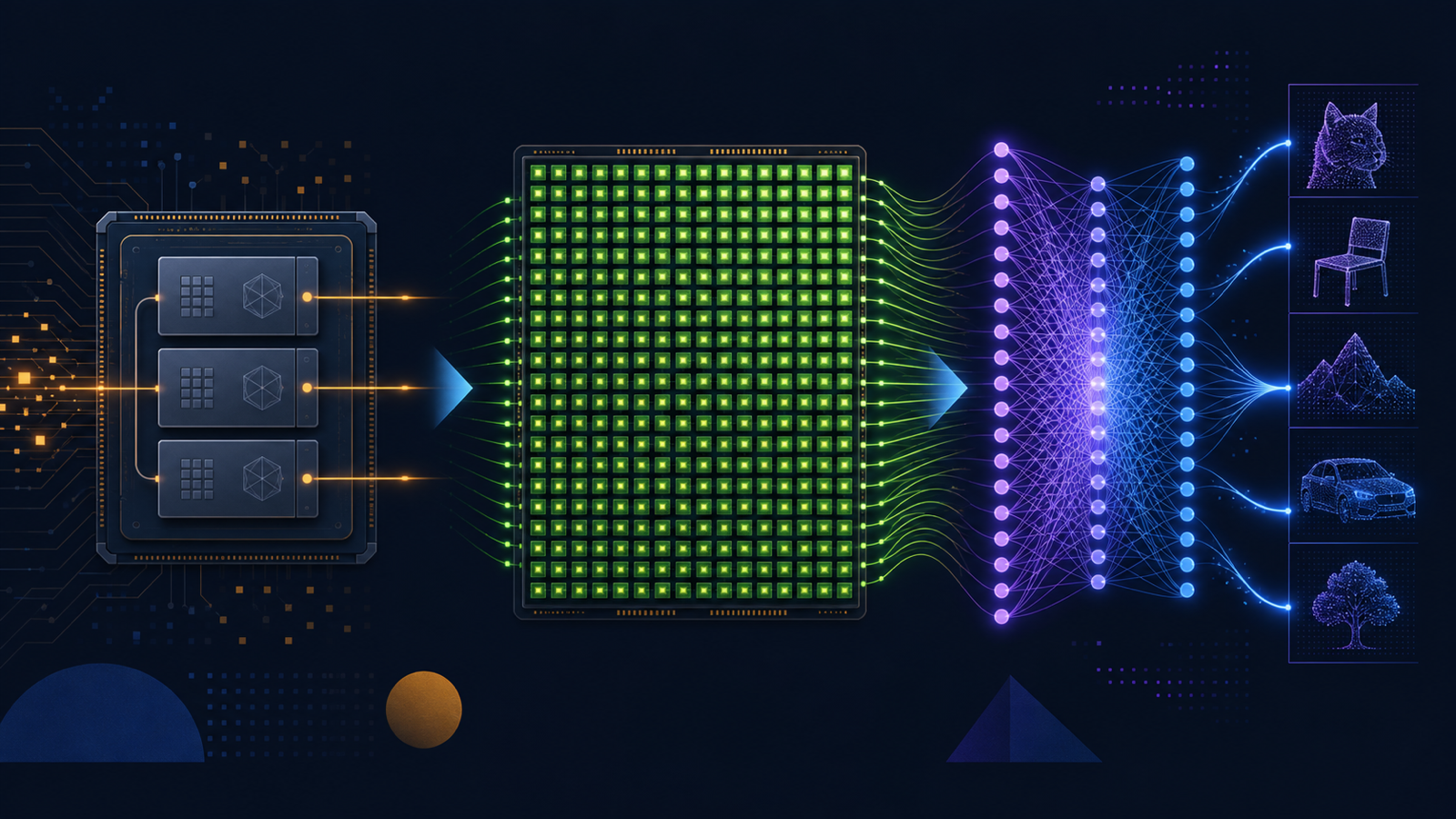
For years this parallelism served only games. Then, in 2006, NVIDIA made a decision that looked expensive and slightly eccentric at the time. It released a software platform called CUDA that let programmers use the GPU for general-purpose maths — physics, weather models, financial simulations — not just graphics. It required years of investment and gave gamers nothing extra. Huang pushed it anyway, arguing that all that parallel horsepower shouldn’t be locked inside video games.
CUDA quietly turned every NVIDIA GPU into a small supercomputer that scientists could program. And it happened to arrive just as a neglected corner of computer science was waking up.
2012: the moment the world turned
Training a neural network — teaching software to learn patterns from examples — requires exactly the kind of massively parallel arithmetic GPUs were built for. In 2012, researchers Alex Krizhevsky, Ilya Sutskever, and Geoffrey Hinton used two NVIDIA GeForce GTX 580 gaming cards to train a neural network called AlexNet on a giant image database. It took about five to six days. When it won that year’s leading image-recognition contest by a stunning margin, the message to the field was unmistakable: deep learning worked, and it worked on NVIDIA hardware.
That result triggered what many describe as an explosion in artificial intelligence. Almost every serious AI lab realised it needed GPUs, and NVIDIA was the only company with both the chips and, crucially, the CUDA software that researchers already knew how to use. The gaming accessory had become the tool of an entire scientific revolution — largely by accident, and partly because NVIDIA had spent years building software nobody had asked for.
The operating engine of the AI economy
From that moment, NVIDIA stopped behaving like a component supplier and started behaving like the foundation of an industry. It poured resources into chips designed specifically for AI, adding dedicated circuitry for the maths that neural networks depend on and building ever-larger systems — Volta, then Hopper’s H100, then the Blackwell generation unveiled in 2024 — that stitched thousands of GPUs into single AI machines.
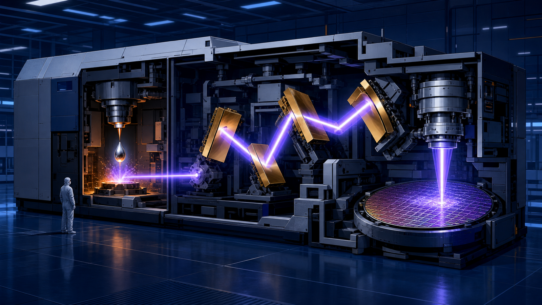
But the deepest advantage isn’t any one chip. It’s CUDA. Nearly two decades of AI software, tools, and researcher habits have been built on top of it, so switching to a rival’s hardware can mean rewriting mountains of code and retraining teams. That accumulated ecosystem is NVIDIA’s real moat: competitors can design a fast chip, but they cannot easily replace the software universe that grew up around NVIDIA’s. Today, the overwhelming majority of the world’s AI models are trained on NVIDIA GPUs. Notably, NVIDIA does not even manufacture its own chips; they are fabricated by TSMC on lithography machines built by a single Dutch company, ASML.
The numbers are almost hard to process. For its 2026 fiscal year, NVIDIA reported record revenue of about $215.9 billion, up 65% in a single year, with roughly 90% of it coming from data-centre chips sold for AI. In the quarter ending April 2026, revenue hit $81.6 billion — in three months — with data-centre sales alone reaching $75.2 billion. A company that once fired two-thirds of its staff to survive now sells more AI hardware in a quarter than most technology giants earn in a year.
What NVIDIA has to solve next
Dominance this complete invites gravity. Its biggest customers — the cloud giants buying tens of billions of dollars of chips — are now designing their own AI processors to reduce their dependence. Rivals are targeting exactly the software lock-in that makes NVIDIA so hard to leave. Governments treat advanced chips as strategic assets, tangling NVIDIA in export controls and geopolitics it cannot fully control. And any boom built on a single, expensive resource carries the risk that demand cools faster than anyone expects.
The lesson underneath the NVIDIA story isn’t that a graphics company got lucky when AI arrived. It’s that luck met a company that had already done the unglamorous work — surviving failure, and building a software platform years before there was an obvious reason to. NVIDIA didn’t predict the AI economy. It spent a decade laying track in roughly the right direction, and when the train finally came, it owned the rails.