





Looking for a Shorter Overview?
AI Summary
Key Moments
Beating Natural Osmosis
Desalination pushes seawater at pressures exceeding natural osmotic pressure to extract fresh water.The Molecular Gate Membrane
Advanced polymer membranes selectively allow water molecules through, blocking salt ions.Energy-Efficient Engineering
Energy-recovery devices recycle pressure from brine to reduce electricity consumption.Maintaining Membrane Performance
Plants combat fouling with pre-treatment, continuous monitoring, cleaning, and scheduled membrane replacement.Nature has a rule about salt water and fresh water. Put a membrane between them — a barrier that lets water through but not salt — and the fresh water will flow toward the salty side, trying to dilute it, until the pressures balance. It is called osmosis, and it is why a freshwater fish dropped in the sea is in serious trouble. Modern desalination plants exist to break that rule on an industrial scale, forcing seawater the wrong way through a molecular gate to leave the salt behind. The audacity of it is easy to miss: these plants win a shoving match against one of the most fundamental tendencies in chemistry, billions of litres at a time.
The requirement is unforgiving. A coastal city may need hundreds of millions of litres of drinking water a day, and it needs that supply to be clean, safe, and continuous — a hospital and a kitchen tap cannot pause because the sea was rough or a filter clogged. Turning the ocean, the most abundant and undrinkable water on Earth, into something dependable enough to bet a city’s health on is the quiet marvel of reverse-osmosis desalination.


The impossible requirement: beat osmosis, on demand
Seawater carries roughly 35,000 to 45,000 milligrams of dissolved solids per litre — mostly salt. Drinking water needs to be under about 500. To strip out more than 99 percent of what is dissolved, and to do it without boiling the ocean (which is enormously energy-hungry), engineers turned osmosis around. If fresh water naturally flows toward salt, then pushing hard enough in the opposite direction will squeeze fresh water out of the salt. That push has to exceed seawater’s natural osmotic pressure of roughly 27 bar — so plants run their membranes at far higher pressures still.
System anatomy: the molecular gate
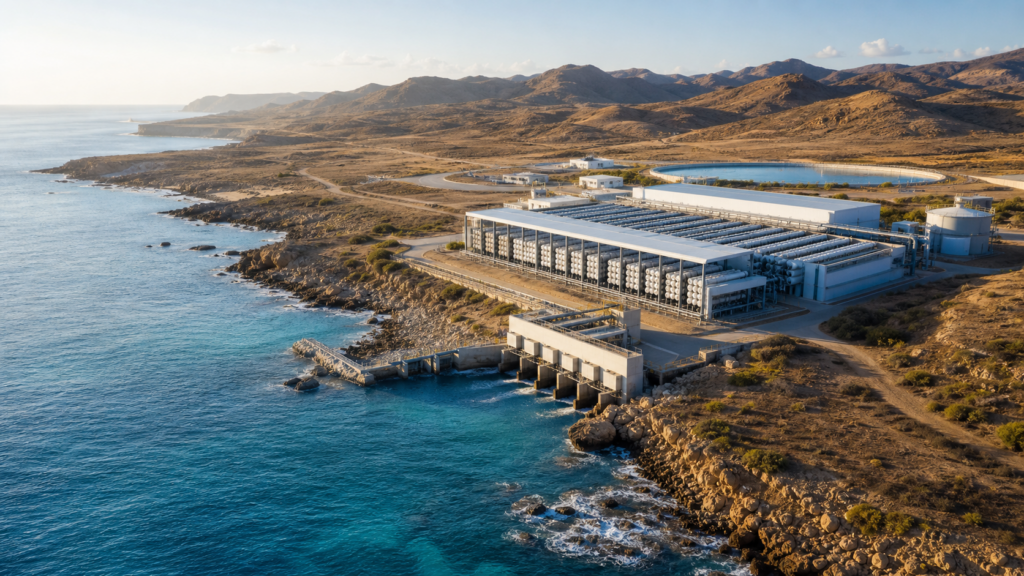
The heart of a desalination plant is the reverse-osmosis membrane: a spiral-wound sheet of polymer riddled with passages so fine that water molecules can slip through while larger, charged salt ions are turned away. This is the “molecular gate.” Seawater is driven against it by high-pressure pumps, typically in the range of about 55 to 80 bar for seawater, and the fraction that makes it through — the permeate — emerges nearly salt-free, while the rejected brine is carried away.
But a raw membrane alone would foul within hours. So the gate sits at the centre of a long chain. First comes intake and pre-treatment: screening out marine life, then filtering to remove silt and microorganisms that would clog the delicate film. Then the high-pressure pumps and the membrane racks. Then post-treatment, because water this pure is actually corrosive and flat-tasting, so minerals are added back before it reaches the network. Every stage exists to protect the fragile molecular gate at the core.
Engineering around failure — and the energy problem
The great enemy of desalination has always been energy. Forcing water through a membrane against nature’s will takes enormous power, and for decades that made desalinated water a luxury. The breakthrough was the energy-recovery device: a clever exchanger that captures the pressure still trapped in the outgoing brine and uses it to help pressurise incoming seawater, recycling energy that used to be thrown away. With these devices, a modern seawater plant can approach around 3.5 kilowatt-hours per cubic metre — a figure that would have seemed impossible a generation ago, even if it still makes the high-pressure pump the single biggest item on the electricity bill.
The other constant threat is fouling — biological growth and mineral scale slowly strangling the membranes. Plants fight it with continuous monitoring, chemical cleaning cycles, and redundant membrane trains so some can be serviced while others keep producing. The membranes themselves are consumables, replaced on a schedule, because the marvel is not a machine that never wears out but a system engineered to keep flowing while its most delicate parts are quietly swapped.
The human build and what it unlocked
Building a plant like Israel’s Sorek facility — one of the world’s large seawater reverse-osmosis plants, built for roughly half a billion dollars — meant coordinating membrane chemists, pump makers, marine engineers, and civil crews, then proving the whole chain could run reliably at a scale where a city depends on it. The payoff is profound. Regions that were hostage to rainfall — Israel, Gulf states, drought-stricken coasts — can now manufacture fresh water from an effectively limitless source. For places facing the same water stress that pressures systems like the Panama Canal’s locks, that changes what is possible.
The lesson of desalination is that some of the most important engineering does not build upward but inward, to the scale of molecules. There is no cathedral here, just a polymer sheet and a very determined pump, quietly winning an argument with chemistry so that a tap in a dry city can keep running. The remaining challenge — the energy it demands and the salty brine it returns to the sea — is now the frontier the next generation of plants is built to solve. For the underlying process, Lenntech’s technical overview lays out each stage.