




Looking for a Shorter Overview?
AI Summary
Key Moments
Flat Route Beneath the Alps
The tunnel stays low and level beneath 2 km of rock, enabling fast, heavy freight transit.Dual-Tube System
Two parallel single-track tubes with frequent cross-passages ensure safety and operational flexibility.Engineering to Manage Rock Pressure
Advanced support and cooling systems address squeezing rock and high temperatures at depth.Transformative Logistics Impact
The tunnel shifts freight from roads to rail, reducing environmental impact and reshaping continental transit.For most of history, crossing the Alps meant going over them: up switchback passes, through snow, at the mercy of the weather and the seasons. The Gotthard Base Tunnel does something that would have looked like fantasy to the engineers who first drilled through these mountains in the 1800s. It goes under them — not through a shoulder of the range, but along a flat line beneath its deepest heart, with as much as 2,300 metres of solid rock pressing down overhead. A passenger train now slips from northern to southern Switzerland in about twenty minutes, in a straight, level line, never climbing, never seeing daylight, while an entire mountain range sits on the ceiling.
At 57.09 kilometres, the Gotthard Base Tunnel is the longest railway tunnel and the deepest traffic tunnel on Earth. It opened in June 2016 after 17 years of construction and a final cost of around 12.2 billion Swiss francs. But the number that matters is not the length or the money; it is the depth, because everything difficult about this tunnel flows from what happens to rock when you dig two kilometres beneath a mountain.
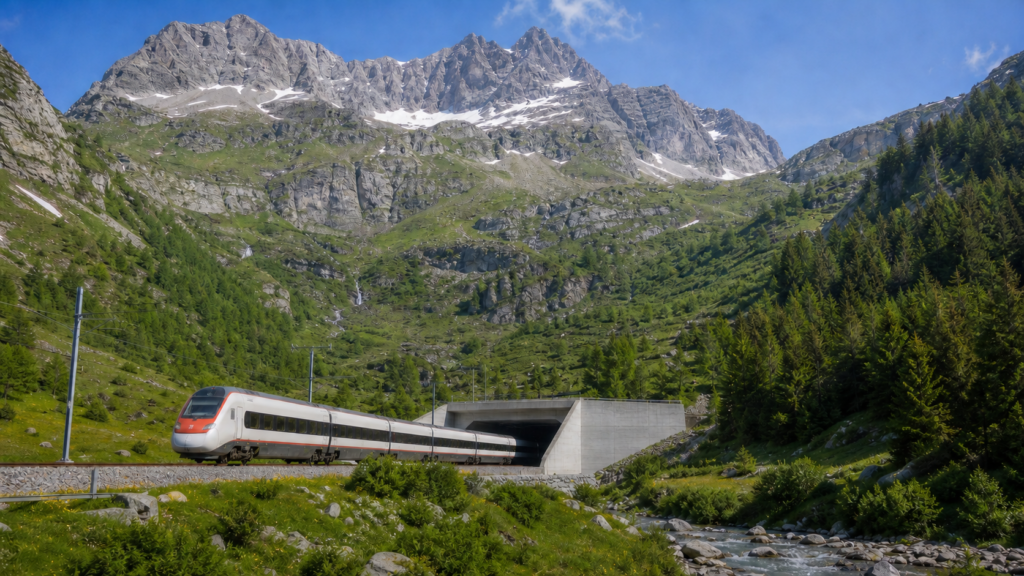

The impossible requirement: a flat line under 2 km of rock
The whole point of a “base” tunnel is that it stays low and level. Older Alpine tunnels climb toward a high point in the middle, which forces heavy freight trains to crawl up gradients and limits how much they can haul. The Gotthard Base Tunnel was built almost flat, deep enough to pass beneath the mountains rather than partway up them, so a fully loaded freight train can run through at speed. Achieving that meant boring straight through the geological chaos at the roots of the Alps — and at those depths, the rock itself becomes the enemy.
System anatomy: two tubes and 152 kilometres of hole
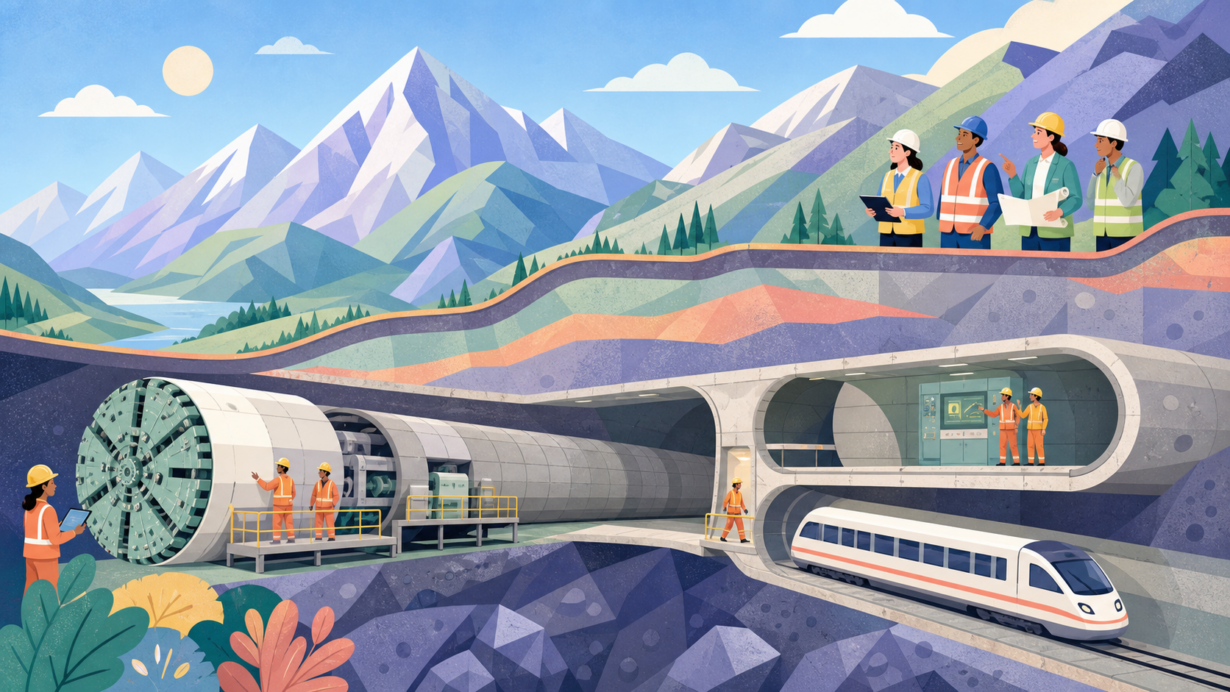
The tunnel is not one bore but two parallel single-track tubes, linked every 325 metres by connecting passages that serve as escape routes and let air and equipment move between them. Counting those cross-passages, access galleries, and shafts, the total length of excavated tunnel reaches about 152 kilometres — nearly three times the headline figure. Two multi-function stations deep inside the mountain hold ventilation systems, emergency-stop platforms, and the crossover tracks that let trains switch tubes.
Much of the digging was done by tunnel boring machines: enormous rotating cutting heads, each hundreds of metres long with its factory of conveyors and segment-layers trailing behind, grinding forward through hard granite and gneiss. Where the rock was too broken or squeezing for a machine, crews fell back on drilling and blasting. The precision was extraordinary: teams boring toward each other from opposite portals, kilometres apart, met with an error of just centimetres.
Engineering around failure
Deep rock does not sit still. Under two kilometres of overburden, stone is under immense pressure, and in weak zones it can squeeze inward, deform supports, and crush a bore closed if it is not restrained. Temperatures at that depth climb toward 46°C, so the working tunnel had to be cooled just to keep crews and machines functioning. Engineers advanced by continuously measuring the rock’s behaviour and adjusting support — heavier linings, yielding elements, and rapid reinforcement — zone by zone, because the mountain’s response could change within metres.
Safety for the finished railway drove the whole layout. The two separate tubes mean a problem in one does not trap trains in the other; the frequent cross-passages give passengers a protected escape; and the deep emergency stations let a troubled train halt somewhere designed for evacuation and smoke extraction. The Gotthard Base Tunnel is, in a sense, an enormous machine for surviving the worst day it might ever have. That design was tested in the real world when a freight train derailed inside it in August 2023, damaging track and infrastructure; repairs kept parts of the tunnel closed until both tubes fully reopened in September 2024.
The human build and what it unlocked
Building it consumed the better part of two decades and thousands of workers, drilling from multiple access points simultaneously to attack the 57 kilometres from several directions at once — a logistical feat of moving people, spoil, and machinery in and out of a mountain around the clock. Nine workers died during construction, a sober reminder of what these depths demand.
What it unlocked is a shift in how a continent moves. The flat, fast route lets far heavier freight trains cross the Alps, pulling cargo off the motorways that thread the valleys and onto rail — the environmental logic that persuaded Switzerland to vote for the project in the first place. Like the Panama Canal’s new locks or the world’s automated ports, it is infrastructure that quietly reshapes global logistics. The deepest lesson of the Gotthard Base Tunnel is that the boldest engineering is sometimes the least visible: a perfectly ordinary train ride, in the dark, beneath the weight of the Alps, made so dependable that passengers forget the mountain is even there. Switzerland’s rail operator SBB documents the tunnel’s full history and specifications in detail.