




Looking for a Shorter Overview?
AI Summary
Key Moments
Gravity-Powered Lock Operation
The new locks use gravity and water flow to lift ships without pumps, enhancing efficiency.Water Conservation Innovation
Water-saving basins recycle about 60% of water during lock cycles to protect fresh water supplies.Expansion to Accommodate Larger Ships
New lock chambers are sized to enable much larger Neopanamax vessels to transit the canal.Climate Impact and Drought Challenges
Droughts reduce lake levels, forcing capacity reductions despite the advanced water-saving design.A container ship the length of three football pitches, loaded with fourteen thousand steel boxes, floats into a concrete chamber with only inches to spare on either side. Gates the size of apartment buildings swing shut behind it. Then, with no pumps running anywhere, the ship begins to rise — lifted metre by metre as water pours in under nothing but its own weight. Twenty minutes later the vessel sits nine metres higher, the far gate opens, and it glides on toward the next chamber. This is how the Panama Canal locks move the largest ships on Earth across a continent: not with brute force, but with gravity, geometry, and astonishing precision.
When the canal’s new, larger locks opened for commercial traffic on 26 June 2016 — the first vessel through was the aptly named Cosco Shipping Panama — they roughly doubled what the waterway could carry and let a whole new class of giant “Neopanamax” ships take the shortcut between the world’s two great oceans. The engineering problem they solved is deceptively simple to state and brutally hard to build: lift enormous ships 26 metres over a mountainous isthmus, thousands of times a year, using as little of a scarce resource — fresh water — as possible.


The impossible requirement: a staircase of water
Panama is not flat. A ship crossing it must be raised about 26 metres to the level of Gatun Lake, carried across, and lowered again on the other side. The canal does this with locks: sealed chambers that fill and drain to act as a liquid elevator. The original 1914 locks were a wonder, but they were sized for the ships of a century ago. As vessels ballooned, the canal faced obsolescence unless it could build a bigger staircase — chambers long and deep enough for ships up to 366 metres long and 49 metres wide, drawing up to 15 metres of water.
System anatomy: chambers, gates, and gravity
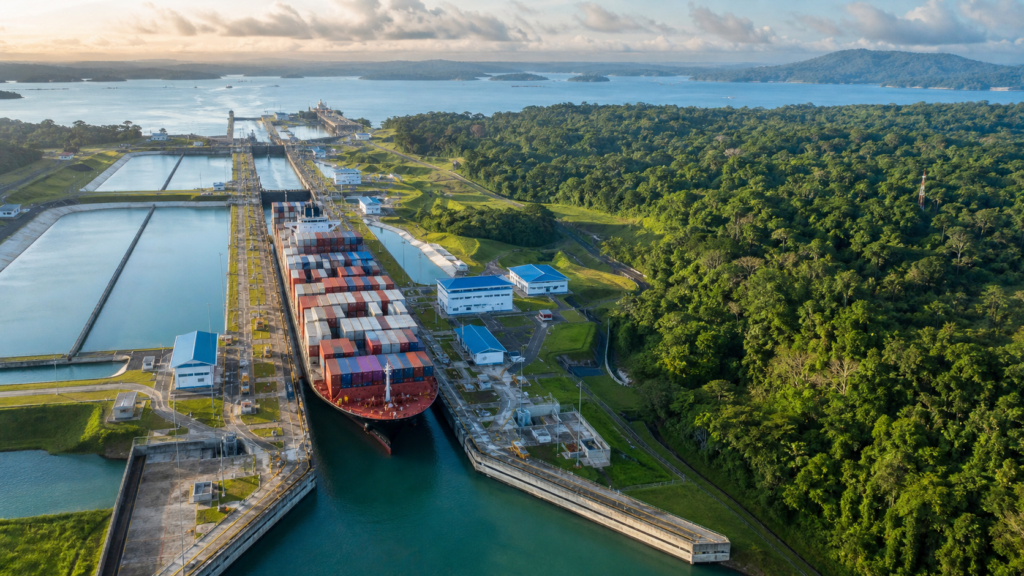
Each new lock chamber is a concrete basin about 427 metres long, 55 metres wide, and 18.3 metres deep — vast enough to hold one of those giants with room to work. Instead of the original miter gates that swung like doors, the new locks use rolling gates: massive steel walls that slide sideways into recesses in the chamber wall, like sliding doors on an enormous scale, easier to maintain because a gate can be rolled out for repair while the others keep working.
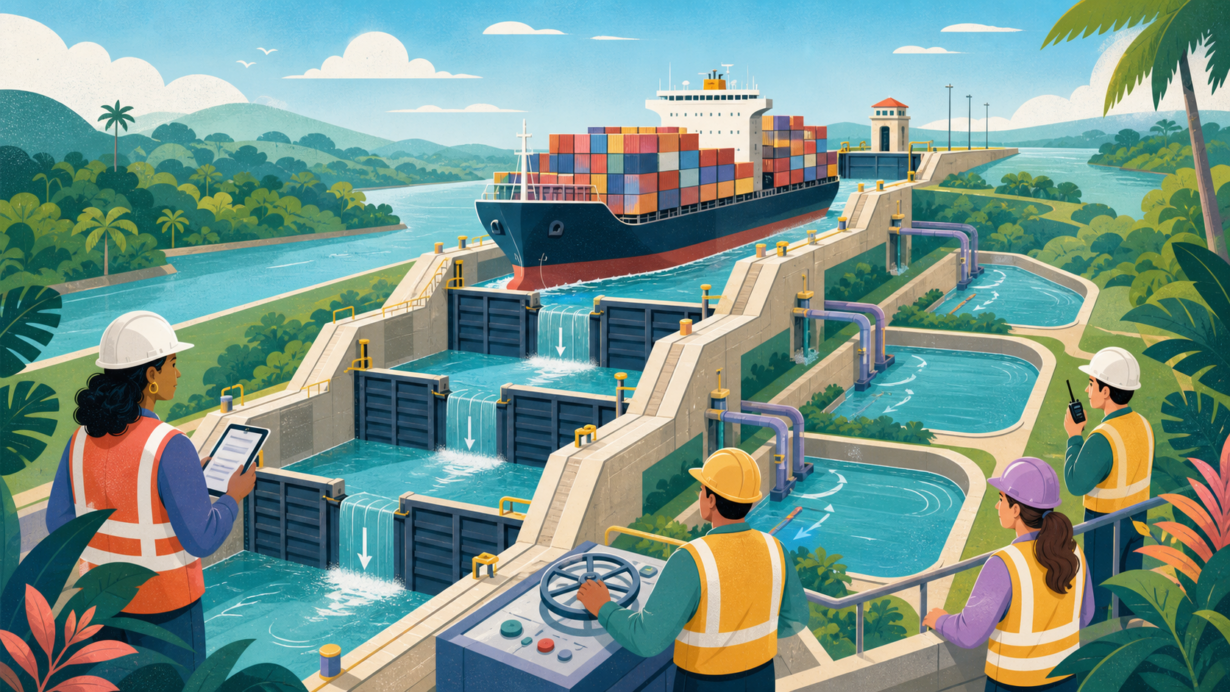
The genius is that the whole system runs on gravity. Gatun Lake sits higher than the sea, so water flows downhill through culverts and valves to fill each chamber and drain it again — no pumps required to lift the ship, only valves to let physics do the work. Tugboats, not the canal’s old locomotives, position the ships. It is less a machine than a very precisely shaped landscape that happens to move ships.
Engineering around failure — and the water problem
Every time a lock cycles, it could send an enormous volume of fresh water rushing out to sea, and fresh water is the canal’s lifeblood: the same Gatun Lake that floats the ships also supplies drinking water to much of Panama. Spend it too freely and the canal drains its own reservoir. So the new locks were built with water-saving basins — three tiered ponds beside each chamber, eighteen in all. Before a chamber empties fully to the sea, much of its water drains sideways into these basins, then flows back to help fill the chamber on the next cycle. The result recycles roughly 60 percent of the water used in each transit, a feat of plumbing that turns a wasteful process into a largely closed loop.
Redundancy is built into the gates and valves so a single failure does not strand a ship or block the world’s shipping, and the chambers are engineered for the immense, shifting loads of water and vessels. But the threat the designers could not fully engineer away is the sky. In drought years — which climate change is making more frequent — Gatun Lake drops, and the canal authority must reduce both ship sizes and the number of daily crossings. The 2023–2024 drought cut the canal’s capacity by roughly a third at its worst, a reminder that even the cleverest water-saving design still depends on rain.
The human build and what it unlocked
The expansion took around nine years and cost on the order of 5.25 billion dollars, drawing together an international consortium of engineers and tens of thousands of workers to pour the concrete, cast the rolling gates, and carve the new channels — all while the century-old canal kept running alongside. What it unlocked was a step-change in global trade: bigger ships mean lower costs per container, reshaping shipping routes from Asia to the east coast of the Americas and rippling out to the automated ports that receive those giant vessels.
The lesson of the Panama Canal locks is that the most elegant engineering often works with nature rather than against it — using gravity instead of pumps, recycling water instead of spending it. Like the Gotthard Base Tunnel beneath the Alps, it is a piece of infrastructure so quietly reliable that the miracle becomes routine. A 200,000-tonne ship rising in silence, lifted by a lake and a few open valves, is what a century of accumulated engineering wisdom looks like when it finally makes the impossible look effortless. The Panama Canal Authority documents the expanded canal and its water-saving basins in detail.